
 1-844-397-8677
The Complete Guide to Concrete Boom Pump Selection
Posted On: 04/29/2026 | Posted by: DY Concrete Pumps
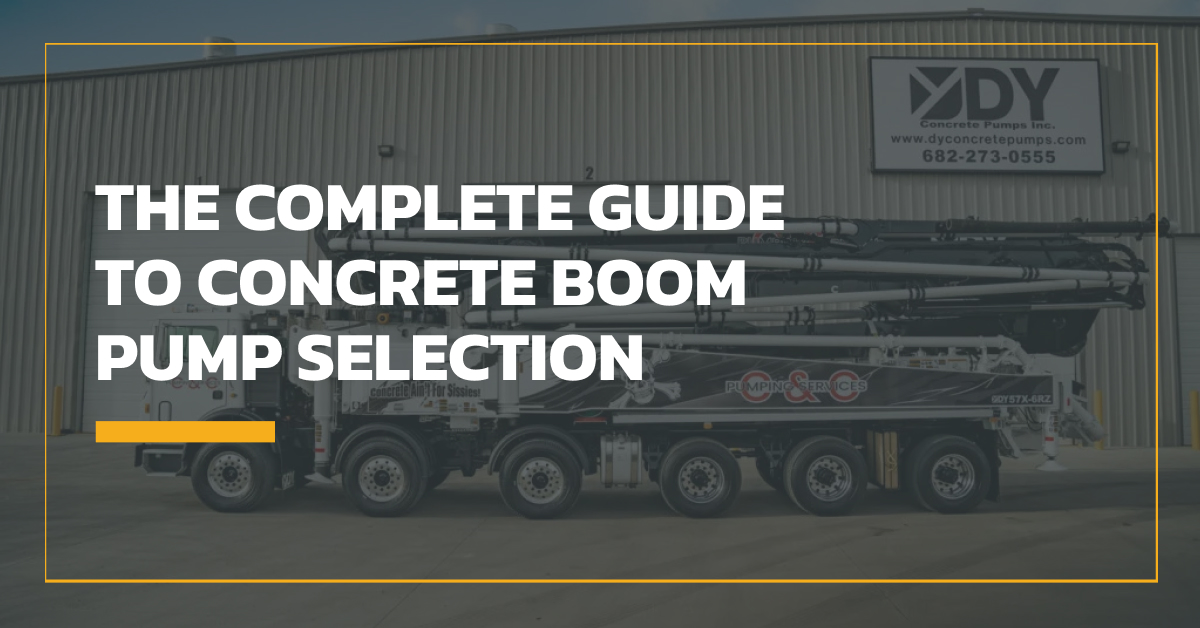
Concrete boom pumps are one of the most important pieces of equipment for construction crews. By facilitating the transport and pouring of concrete, they open up new architectural possibilities. They also directly impact the overall efficiency, profitability and quality of projects. This equipment can also be quite expensive. All these factors together can make concrete boom pump selection difficult, especially when considering which technical specifications will best suit your projects.
Here, we will dig into all these factors and more to help you narrow down your options and find the perfect boom pump for your crew.
Understanding Your Project’s Specific Demands
Every construction project comes with unique needs and limitations that will make some pumps better for the job than others. The features of each pump will also affect its performance.
Before jumping in headfirst, assess your project’s specs and requirements. Typically, these demands come in three forms:
- Reach
- Pump capacity
- Concrete mix
Explore the importance of each project demand below.
Assess Vertical and Horizontal Reach
The primary value of the concrete boom pump is its ability to flex as needed. The boom allows these pumps to work in both elevated environments and those that are difficult to reach or maneuver in. Extended access opens up new opportunities for both architects and construction crews.

Not all boom pumps are created with the same reach. Before choosing a concrete pump, you must think about the following specs:
- Vertical reach: Your boom pump’s vertical reach is affected by more than just the length of the boom itself. Most manufacturers will list the length of the boom sections, but the actual vertical reach is measured from the turret’s center to the end hose, which is often slightly shorter. Obstacles may also force the boom to shorten its length to get around them.
- Horizontal reach: The length from the turret’s center to the end hose also impacts the boom pump’s horizontal reach. However, truck position is also a huge factor when working at or below ground level. Poor placement can limit the truck’s reach, especially if the pour area is unusually shaped. Obstacles remain an issue when working horizontally as well, so they must also be accounted for when estimating horizontal reach.
Whether you’re working vertically or horizontally, a safety buffer between the truck and nearby hazards must also be maintained. Power lines, for instance, can complicate truck placement and boom pump handling. If the safety buffer is not in place, accidents could very easily occur.
Concrete boom pumps also need additional space to unfold and stretch to their full length. Oftentimes, the safety buffer accounts for this already. In other situations, you need to assess the space you have and ensure the boom can utilize its reach within that space.
Always consult with an expert to ensure you get the correct reach for your projects.
Match Pump Output to the Scale of the Project
Your pump’s output in cubic yards/meters per hour will have a direct impact on its efficiency. Some pumps may not have the output necessary for a given job’s scale, whereas others may be too fast for the precision a particular job requires.
Commercial slabs and warehouse floors, for example, often benefit from high-output machines. More complex architecture, however, will likely be better served by a pump with a lower output. It’s important to understand how large a job is going to be before committing to a specific boom pump.
Ideally, the pump output should also align with the ready-mix plant’s batching speed — the rate at which they produce batches of new ready-mix concrete. Should the pump output and scale of projects in your area surpass the plant’s ability to provide ready-mix concrete, your construction may experience significant downtime.
This can delay project completion and increase expenditure unnecessarily. That said, a high-output pump can still be used in situations like these, as its output can be lowered manually. A low-output pump cannot raise its output past its maximum, however. An equipment expert can provide clarity on the output necessary for your unique applications.
Evaluate the Project’s Concrete Mix
The concrete mix your project requires will only be compatible with certain boom pumps. Each mix has a nominal maximum aggregate size (NMAS), which refers to the smallest sieve size that will allow only 15% or less of the aggregate to remain within the sieve.
If a boom pump pipeline system is smaller than this size, it will likely become blocked, halting pour progress and requiring extensive cleaning. Repeated blockages only compound these delays.
Harsher mixes, such as those with low cement content, manufactured sand or sharper aggregates, can also be more difficult for boom pumps to use. Boom pumps with robust valve systems and high-pressure hydraulic systems can handle them, but less powerful pumps may not be able to keep up.
Slump, or the consistency of the concrete mix, can also limit the boom pumps that can be used. Dry mixes will not be able to move through longer boom pumps effectively, whereas a wet mixture can separate into its constituent components within the pump. The driest and wettest mixes may not function within longer boom pumps at all.
So, when choosing a concrete pump, be sure to assess the quality of the concrete mix and its compatibility with the boom pumps you’re considering. Consult with an expert if you have questions about your concrete mixtures.
Compare Technical Specifications
Once you’ve evaluated your project’s needs, it’s time to think about how to meet them. Concrete boom pumps all come with unique technical features that make them better suited for certain jobs. To pick a pump, align your project’s requirements with a pump’s technical specifications.
When aligned perfectly with the project in question, the pump will enhance efficiency and lead to a higher-quality pour. Below are some key specifications to evaluate when making your choice.
Boom Folding Systems
The structure of the boom mechanism can vary from pump to pump. The two primary designs are:
- Z-fold booms: These mechanisms unfold in a Z pattern from a stable, stationary base. They fold and unfold quickly. The Z-fold mechanism is also extremely compact, allowing it to function within buildings, under bridges and in other tight spaces. The tip of the boom is also precise and easy to maneuver. Vertical jobs often use Z-fold booms.
- Roll-and-fold booms: These mechanisms work a bit differently. Rather than unfolding in a Z pattern, these boom pumps roll toward the front of the truck and unfurl outward simultaneously. This simple design gives them excellent horizontal stability and allows them to easily pass over and around obstacles. Horizontal jobs often use roll-and-fold booms.
Some boom pumps leverage a hybrid of the two, which can facilitate both horizontal and vertical projects. These pumps may not excel in either category, but they can function in both tight, vertical spaces and over larger horizontal pour areas. This flexibility is an asset for many construction crews. Others may prefer the specificity and focused excellence of Z-fold booms and roll-and-fold booms.

Outrigger Footprint
When setting up a boom pump, you need to consider both the size of the truck and the size of the outriggers attached to it. These mechanisms extend outward from the truck and plant on the ground below, providing a stable base for the boom mechanism. Typically, they need to extend far out from the truck to do so. However, they aren’t always the same size.
The two main types of outriggers are:
- X-style outriggers: These outriggers extend directly out from the corners of the truck before lowering. Because they mirror the shape of the truck, they tend to be narrower. They can be used in tighter environments, making them highly compatible with Z-fold booms.
- Swing-out outriggers: Also called butterfly outriggers, these mechanisms take up a bit more space than their X-style counterparts. They pivot outward from the base of the truck and lower from there, allowing them to provide a strong base at the cost of taking up more space. Swing-out outriggers are often used for larger boom pumps, as they provide excellent stability.
Many modern boom pumps come equipped with short-rigging systems, which allow the outrigger to partially deploy on one side. The boom is locked onto that side, which prevents it from tipping the truck. This mechanism can help boom trucks work within tighter constraints when necessary.
The outrigger may also be constrained by the ground in some cases. Soft soil and asphalt can crack or give under the pressure exerted by the outrigger pads, so be sure to assess the weight of the outrigger in relation to the terrain before committing to a boom pump. Dunnage pads can help support this load, but they won’t always be enough.
Weight and Chassis Design
The weight and design of the chassis itself can also impact which boom pumps are viable for a given job. Longer booms require heavier trucks and counterweights, which need more axles to support them. As a result, further-reaching trucks tend to be larger, longer and harder to maneuver. This can make them unusable in certain terrains or in spaces too tight for the truck to work in.
Smaller trucks may not have the reach required for a given job. As a result, the decision between the two is often made by the environment and the project requirements. If a heavier truck can’t reach the pour space, you may have to settle for a reduced reach. If a lighter truck can’t reach far enough, you likely need to invest in a larger boom pump.
Your boom pump choices may also be limited by the fact that some regional laws restrict truck weights on the road. Delaware, for example, has an 80,000-pound maximum limit on 5-axle trucks traveling on U.S. numbered routes and interstates. If your 5-axle boom pump surpasses that, it cannot be driven in these areas.
The only way around these restrictions is to either invest in a lighter vehicle or to use tag axles. These handy devices can be lowered when needed to provide an extra axle and reduce the overall weight per axle. They can be raised when on-site to make the truck shorter and more maneuverable.
Choose a Concrete Boom Pump for Long-Term Value
The last factor you should consider is the long-term value of the boom pump. Not all pumps are created equal, and some are capable of lasting far longer than their counterparts. Longevity is often tied to the following:
- Durability: The truck, the boom pump and all the mechanisms therein must be durable enough to survive extended use with minimal wear. Gradual degradation is inevitable, but the best pumps in the industry can resist rust and weather conditions for many years.
- Maintenance and service requirements: Inevitably, your boom pump will need repairs. Smaller components and even some larger parts can be repaired fairly easily. Engine damage, a collapsed boom and other significant damage can pose a larger challenge, however. The best boom pump manufacturers make all types of repairs easier by having the necessary parts on hand. These parts can be shipped out to mechanics or to the site for repairs. Other manufacturers can’t provide this service.
- Manufacturer support: The boom pump manufacturer should support the health of the boom pumps they make. They can do this by including user manuals with the vehicle, providing repair parts to users and offering vehicle service to local users. They use their firsthand expertise to extend your boom pump’s lifespan, whether by conducting repairs themselves or warning of ways the boom should not be used.
Be sure to assess each of these factors before choosing a particular boom pump. While investing in a more robust vehicle may be more expensive at the outset, it can save you money in the long run by avoiding costly repairs. It can also last longer, which means you won’t need to replace it as quickly. A higher-quality pump may also come with additional features that make work more efficient.

Find the Right Concrete Boom Pump With DY Concrete Pumps Today
DY Concrete Pumps offers diverse concrete boom pump options. We have provided top-quality concrete pump technology to companies across Korea for years, and we bring that same quality to the North American market.
Each of our pumps is designed with operators in mind. Both controls and maintenance are simple and beginner-friendly. We also offer 24/7 technical support and an extensive inventory of replacement parts if you need help resolving a problem or conducting repairs.
To learn more about our concrete pumps, including our array of boom pumps, fill out our contact form or reach out at 1-844-397-8677 today.


